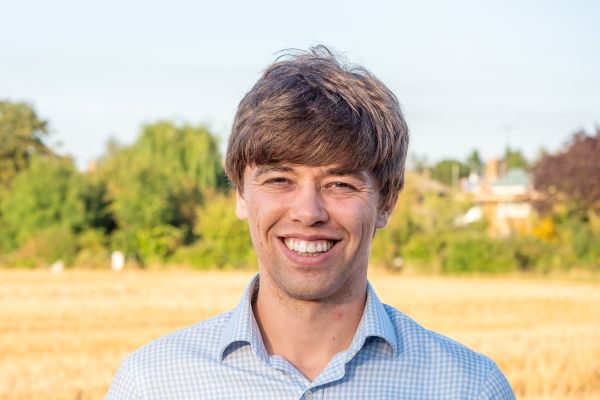
A version of this article by Cllr Cameron Holloway, Leader of the council (pictured), was first published in Cambridge Independent on 25 March 2026.
Waking up to daily headlines of war and brutality, it can sometimes feel as if our efforts to improve our small part of the world are all for nothing. But this horrible news is also a reminder of how precious our peace and democracy are, and how important it is to work to preserve and strengthen them.
‘Democracy’ is not a steady state. It can be eroded very quickly, as we are seeing so starkly in the United States. Yet it is important not to give in: faith in democracy can also be restored and deepened. That’s what we, in our own small way, are trying to do here in Cambridge.
When the government asked us whether we wanted to postpone this year’s council elections, to help to free up capacity for local government reorganisation, we wrote back with a strong ‘no’. Local government reorganisation is a challenging process, but, with big decisions coming up, it’s vital that Cambridge residents have their say on who represents them in the coming years.
And we’re going further: we know it’s not always easy to find time to vote, so, for this year’s Cambridge City Council elections, we're trialling early voting - Cambridge is one of just four councils across the country selected to explore new ways of making voting more convenient. Cambridge voters will be able to cast their ballot at one of three sites – Meadows Community Centre, Clay Farm Centre, and The Guildhall – from 9am to 6pm on the Thursday, Friday and Saturday before polling day.
Elections are essential to local democracy, but they’re not enough on their own to build trust. Local people need a real say in major decisions affecting our area.
The government has big plans for Cambridge, with a proposed development corporation looking to build new homes and infrastructure to accelerate economic growth over the next 25 years. The far-reaching nature of these proposals means that serious local involvement is vital. That’s why we’re fighting to keep planning powers under the democratic control of the local council, instead of them mostly being assumed by the Development Corporation, as currently proposed by the Government.
Our emerging joint Local Plan for Greater Cambridge, which sets out plans for housing, jobs, infrastructure and the natural environment for the next 20 years, has already had input from thousands of residents. For our latest consultation, we held 100 separate events, to make sure we heard from as many people as possible. That is the value of local democratic control – we represent residents, and work directly with residents, in a way that an unelected development corporation never could.
We know that there’s always more we can do: we need to hear from residents all year round, and involve people in decisions that affect them, particularly people who might not always be the first to come forward.
As long as consultations require people to come to us, rather than the other way around, we’ll get an unrepresentative sample of the population. That’s why we’re shifting our focus to engagement that takes place in our communities. Talking to people at events like The Abbey Big Lunch, Mill Road Winter Fair or Arbury Carnival may not feel like a formal council consultation – but, in a way, that’s the point. We need to lower barriers to people getting involved and having a say.
To give an example of a specific project: I and fellow councillors, and council officers much more so, have spent many hours in recent months meeting and hearing from residents about what they would like to see in North Cambridge, and working together to develop proposals for new council housing, safer streets, and improved parks and open spaces through an ongoing dialogue.
We’re also ensuring that young people are involved in discussions about the present and future of Cambridge. Our Youth Assembly told us that they wanted easier access to good training, skills and job opportunities: now we’re working with young people to develop an overarching project aimed at promoting equitable opportunity for all young people in Cambridge – Included.
Working deliberatively, alongside communities, is not easy, but, by putting the hard work in and engaging with the diversity of thought and perspective that exists in our city, we can hope to build a better future for us all.